Resin flooring Luton
How thick should an epoxy floor be?
Find out what thickness your floor needs before you compare prices. Send a short description of your space and get a clear idea of what to ask for, at no cost.
Thin coatings and how many coats an epoxy floor needs
A roller-applied coating sits on top of the concrete rather than building a new surface. Most thin systems measure between 0.3mm and 0.5mm per coat. The total epoxy coating thickness mm depends entirely on how many coats the specialist applies and whether they broadcast aggregate into the wet resin for grip.
These coatings seal dust and resist light foot traffic. They work well in storage rooms or areas where nothing heavier than a pallet truck crosses the floor. But a thin film cannot absorb impact. If a steel pallet drops on it, the concrete underneath takes the blow and the coating cracks with it.
When comparing resin floor quotes across Luton, check whether the price covers one coat or three. A single pass of a roller costs far less but leaves almost no protection against wear. Ask the specialist exactly what thickness they are laying down so you know what you are paying for.
Self smoothing resin and the depth that matters
A self levelling resin floor depth usually starts around 2mm and goes up to 4mm. The mixed resin pours out and finds its own level, filling minor hollows in the concrete to leave a flat, continuous surface. This is a different process from painting. It builds a distinct layer that can take moderate rolling loads without transferring every bump to the slab below.
Units across Luton use these systems where trolleys and small electric vehicles move goods daily. The extra depth gives the floor enough body to resist scuffing and minor impacts. It also hides the texture of the old concrete, which a thin coat would simply follow.
The price per square metre rises because more material goes down and the preparation demands more care. The slab must be ground clean and dry before the pour. Any moisture trapped under a self-smoothing layer will bubble through later, so specialists test the concrete first. Read more about moisture risks on the damp concrete page.
Heavy duty resin screed for constant loading
Where forklifts turn tightly and loaded pallets drag across the ground, a heavy duty resin screed is the standard choice. These systems run from 4mm to 9mm thick, sometimes more. They contain graded quartz aggregates packed into the resin, giving the floor compressive strength that thin coatings lack entirely.
If you move steel stillages or drop heavy items regularly, this is the build that survives it. The thickness spreads point loads across a wider area of the concrete beneath, stopping the slab from cracking under repeated stress. Warehouses and manufacturing units around Luton rely on these screeds precisely because lighter options fail within months under that kind of punishment.
A specialist firm calculates the required thickness by looking at wheel type, load weight, turning radius and how often the traffic repeats the same path. There is no single right number. A resin floor for forklift use in a quiet dispatch bay might need 6mm, while a production aisle taking constant abuse could demand 9mm. Getting this wrong means paying twice.
Why quotes differ when you compare resin floor prices
Thickness drives durability, and it changes what you are paying for. When comparing resin floor quotes, the numbers only make sense if you know what each specialist is laying down. A quote for a 0.5mm roller coat will always be lower than one for a 4mm self-smoothing system because they are not the same product.
Some firms price per coat, others per millimetre of build. Material volume scales with thickness, so more resin means more material. A thicker floor also takes longer to prepare and apply. Surface grinding, moisture testing and priming all add time before any resin touches the concrete.
Ask for the total dry film thickness in writing. Find out whether the figure includes preparation, primer and topcoat. Without those details, the lowest number might simply describe the thinnest floor. A clear specification lets you judge what you are getting.
What the specialist checks before deciding on thickness
A specialist firm does not guess the thickness. They survey the concrete, measure its moisture content, check for existing damage and map out the traffic routes. Forklift wheels exert far more pressure than pedestrian boots, and solid rubber tyres behave differently from pneumatic ones. Every variable changes the calculation.
They also look at falls and drainage. A thicker build raises the finished level. If the floor needs to slope toward a channel drain, adding 6mm of screed might block the flow or create a step at the doorway. The specialist plans the edges and transitions before pouring anything.
In older Luton industrial units, the existing slab might be uneven. A self-smoothing system can hide minor variation, but deep hollows need patching first. Floor preparation determines whether the resin bonds properly or lifts away later. The survey identifies all of this so the thickness specified actually performs as intended.
Signs your resin floor is too thin for the traffic
A floor that lacks the depth for its workload fails visibly. The damage follows the traffic pattern and gets worse until the concrete underneath begins to break up too.
- 1
Tyre marks that will not wash off
Dark lines appear along forklift routes. This suggests the coating is too thin to resist friction heat from solid rubber tyres turning under load.
- 2
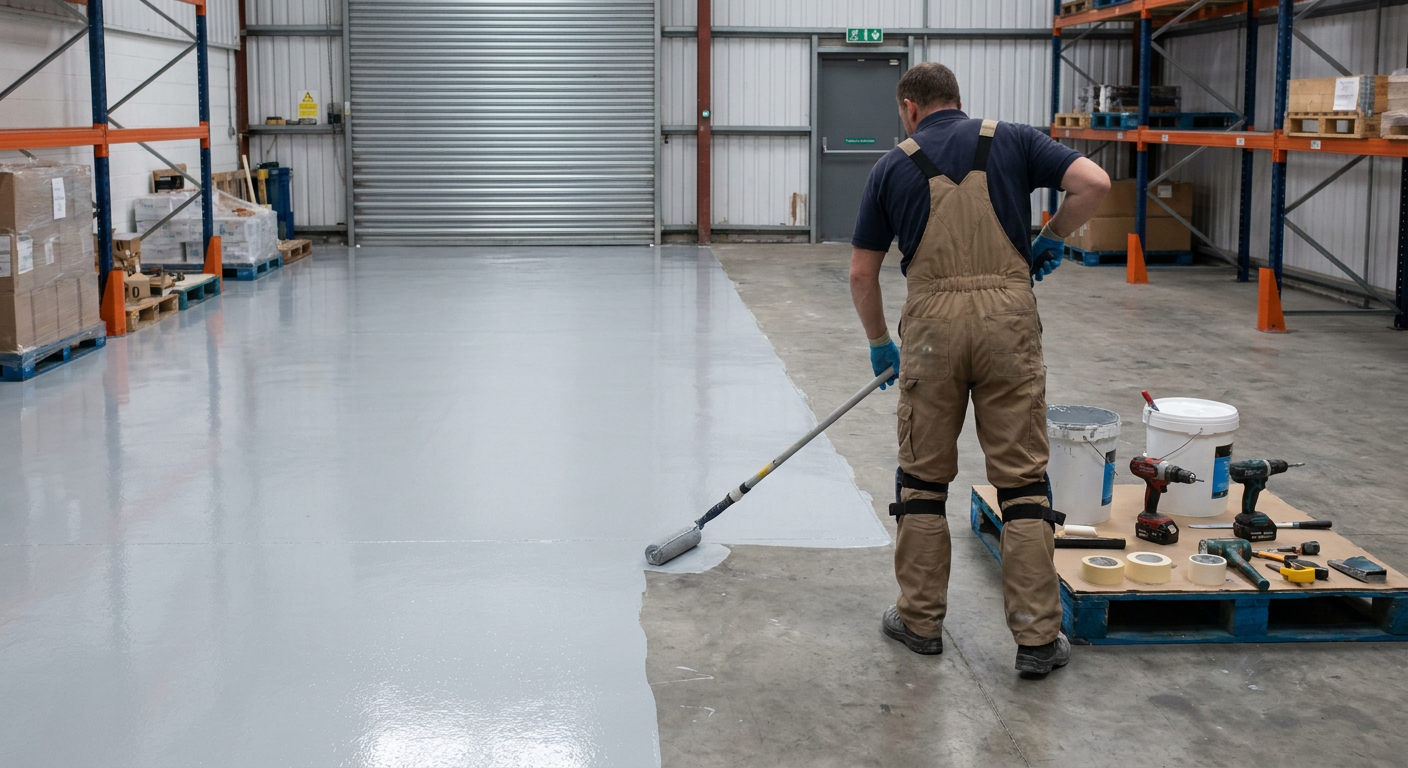
Chips near racking uprights
Small pieces flake away where pallets are set down. Thin resin cannot absorb the impact, so it fractures and exposes bare concrete beneath.
- 3
Worn paths along main aisles
The finish looks duller in straight lines where traffic concentrates. The top layer has eroded completely, leaving only primer or raw slab visible.
- 4
Bubbling around drains
Raised blisters form where water pools. Moisture may have pushed through a thin coating that lacked the density to act as a vapour barrier.
Questions about resin floor thickness
How thick should the epoxy be for a Luton warehouse with forklifts?
Most warehouses running regular forklift traffic need a heavy duty resin screed between 4mm and 9mm thick. The exact depth depends on axle loads, tyre type and how often trucks turn in the same spot.
Why is one quote much cheaper per square metre than another?
Because the thickness differs. A 0.5mm roller coat uses a fraction of the material a 4mm self-smoothing pour requires. Always compare the specified dry film thickness, not just the final price.
Roller coating or self smoothing screed?
A roller coating paints a thin film onto the surface, typically under 1mm. A self-smoothing screed pours out at 2mm to 4mm, filling hollows and creating a new flat wearing course that handles rolling loads.
Do I need a heavy duty screed if we move steel and pallets about?
Yes. Steel pallets and heavy stillages concentrate enormous point loads. A thin coating will crack on impact. A heavy duty resin screed spreads that force and protects the concrete slab underneath.
Does a thicker floor take longer to cure before we can use it?
It can. Thicker layers generate more heat during the chemical reaction and need longer to reach full hardness. Light foot traffic might be fine overnight, but driving forklifts over it too soon will mark the surface.
Will a thicker build up cause problems at doorways and drains?
It can raise the finished level enough to block drainage falls or create trip hazards at thresholds. The specialist surveys these transitions beforehand and adjusts the design to keep everything flush.
Can a thin coating be built up later if traffic increases?
No. You cannot simply paint another layer over a worn thin coat and expect it to perform like a screed. The bond will fail. The old coating needs removing and the correct system applying from scratch.
How do you work out the loading on my floor during the survey?
The specialist records vehicle weights, wheel types, turning circles and frequency of use. They calculate the point load each wheel exerts and specify a thickness that distributes it safely into the concrete slab.
Tell us about your floor
Send a few details about your space and the traffic it takes. A specialist firm will review the information and explain what thickness makes sense, with no obligation to proceed.
- No obligation
- Free to ask
- Clear answers